

Mechanical Seals
Mechanical seals, like gaskets, serve the critical function of preventing leakage in systems that transport fluids or gases. However, while gaskets are typically used in static sealing applications (such as flanges or static joints), mechanical seals are used in dynamic sealing applications, specifically in systems with rotating parts, such as pumps, compressors, or mixers.
Mechanical seals are most commonly used in rotating equipment where the shaft passes through a housing, and they must prevent fluid from leaking between the rotating shaft and the stationary housing. They provide a reliable and efficient way to contain high-pressure fluids in dynamic systems.
Helpful Link(s): https://youtu.be/_lGkOLmUIQs?si=VCNPI9OmOL2KD9rY
1. Types of Mechanical Seals
There are several types of mechanical seals, categorized by their design and how they function. These include:
A. Pusher Seals
-
Design: The seal face moves axially along the shaft as it compensates for wear or thermal expansion.
-
Application: Commonly used in pumps where shaft movement is minimal.
-
Advantages: Self-adjusts to wear and misalignment.
-
Disadvantages: Susceptible to contamination and can suffer from spring fatigue over time.
B. Non-Pusher (Bellows) Seals
-
Design: Uses a flexible bellows instead of springs to hold the seal faces together. The bellows compensates for misalignment and axial movement.
-
Application: Suitable for applications with high-temperature fluids or where corrosion resistance is important.
-
Advantages: Less wear due to fewer moving parts and resistant to clogging.
-
Disadvantages: Bellows are more fragile and may not handle extreme pressures well.
C. Balanced Seals
-
Design: The hydraulic forces acting on the seal faces are balanced, reducing the pressure on the seal faces.
-
Application: Used in high-pressure environments, such as high-speed pumps or high-pressure systems.
-
Advantages: Reduced wear and heat generation, allowing for longer seal life in high-pressure applications.
-
Disadvantages: More complex design and can be more expensive than unbalanced seals.
D. Unbalanced Seals
-
Design: The hydraulic pressure is not balanced, causing higher pressure on the seal faces.
-
Application: Best for low-pressure applications where simplicity and lower cost are priorities.
-
Advantages: Simple and cost-effective for low-pressure systems.
-
Disadvantages: Increased wear on seal faces and not suitable for high-pressure applications.
E. Cartridge Seals
-
Design: Pre-assembled mechanical seals in a cartridge form for easier installation and replacement.
-
Application: Widely used in industrial pumps and mixers for standardized and straightforward sealing solutions.
-
Advantages: Easy to install, reduces the chances of misalignment, and improves reliability.
-
Disadvantages: More expensive than custom or component seals due to pre-assembly.
F. Gas Seals
-
Design: Use a thin film of gas between the seal faces to minimize wear and friction.
-
Application: Primarily used in compressors and systems where liquids cannot be tolerated.
-
Advantages: Virtually no wear due to lack of contact, and the ability to handle high speeds.
-
Disadvantages: Requires precise design and alignment, and cannot handle liquid sealing.
2. How Mechanical Seals Work
The working principle of a mechanical seal involves two flat, highly polished surfaces (the seal faces) that press against each other. One face is stationary (attached to the pump housing) and the other is attached to the rotating shaft. A thin layer of fluid or gas (called the lubricating film) is maintained between these surfaces to reduce friction and prevent wear.
-
Primary Sealing Faces: These faces are responsible for creating the seal by maintaining a tight interface, preventing leakage of the fluid along the shaft.
-
Secondary Seals: These are gaskets or O-rings used to seal the points where the seal parts are fixed to the housing and shaft.
As the shaft rotates, the seal faces move relative to each other, but the combination of hydraulic pressure, spring force, and lubrication film keeps the faces tightly together, preventing fluid leakage. This makes them ideal for high-speed and high-pressure applications, where gaskets or packing would wear out quickly.
3. Why We Use Mechanical Seals
Mechanical seals are used because of their superior performance in dynamic sealing applications where other sealing solutions like gaskets would fail due to wear and friction. The main reasons for using mechanical seals include:
-
Leak Prevention in Rotating Equipment: Mechanical seals provide a more reliable solution for sealing rotating equipment like pumps, compressors, and mixers compared to packing or gaskets.
-
Reduced Maintenance: Unlike packing, which requires frequent tightening or replacement, mechanical seals last longer and require less maintenance.
-
Pressure and Temperature Handling: Mechanical seals can handle higher pressures and a wider range of temperatures than soft gaskets or packing.
-
Efficiency and Reduced Friction: They offer lower friction between surfaces, which reduces energy loss and wear compared to packing methods.
4. Mechanical Seals vs. Gaskets: A Comparison
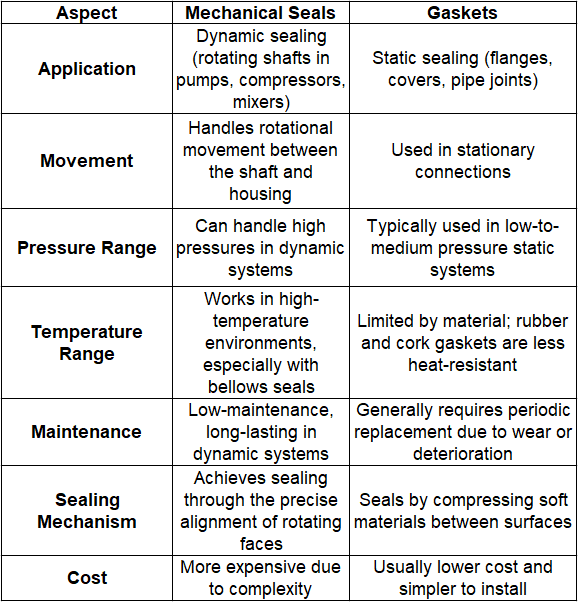
5. Pros and Cons of Mechanical Seals
Pros:
-
High Reliability: Mechanical seals provide a leak-proof solution for dynamic sealing applications.
-
Efficiency: They reduce friction and wear, ensuring higher energy efficiency in rotating systems.
-
Durability: Mechanical seals last much longer than traditional packing or gaskets in dynamic systems.
-
Wide Range of Applications: Suitable for high-pressure, high-temperature environments, and for use with corrosive and abrasive fluids.
-
Reduced Downtime: Less maintenance is required, which reduces the downtime associated with replacing or adjusting seals.
Cons:
-
High Initial Cost: Mechanical seals are more expensive upfront compared to gaskets or packing.
-
Complex Installation: Installing mechanical seals can be more complicated, especially for non-cartridge designs, requiring precise alignment.
-
Sensitivity to Contamination: Mechanical seals are sensitive to contamination by particles, which can damage the sealing faces and lead to failure.
-
Not Suitable for All Applications: Mechanical seals are not ideal for low-pressure, non-rotating systems where simpler solutions like gaskets or packing are more cost-effective.
6. Applications of Mechanical Seals
Mechanical seals are used in a variety of industries and applications, particularly where rotating shafts and dynamic sealing are involved:
A. Pumps
-
Centrifugal Pumps: Used in water treatment plants, chemical industries, and oil refineries to prevent leakage at the pump shaft.
-
Positive Displacement Pumps: In applications where high pressure is involved, mechanical seals provide reliable sealing of the pump shaft.
B. Compressors
-
Gas Compressors: Mechanical seals are used to prevent gas leaks in compressors handling high-pressure gas systems in refineries, petrochemical plants, and gas transportation.
C. Agitators and Mixers
-
Mixing Equipment: Mechanical seals are used in industries such as pharmaceuticals, food processing, and chemical production, where agitators and mixers require reliable sealing to prevent contamination.
D. Oil and Gas Industry
-
Drilling Equipment: Mechanical seals provide reliable sealing in high-pressure drilling equipment, pumps, and compressors used in oil extraction and processing.
E. Power Generation
-
Steam Turbines: In power plants, mechanical seals are used to seal steam turbines, preventing leaks of high-temperature steam and maintaining efficiency.
F. Food and Beverage Industry
-
Sanitary Pumps: Mechanical seals are used in food and beverage processing equipment, where contamination prevention and clean operation are critical.